
 Tiếng Việt
 日本語
日本語


 How to Evaluate a Vietnam Metal Parts Supplier: 7 Questions to Ask
Finding a metal parts supplier in Vietnam who can actually build what you need — at the right price — is harder than it looks. The country has thousands of suppliers, and most will say yes to your inquiry regardless of whether they can genuinely deliver.
The real question is not whether a supplier can machine your part. It is whether they can machine *your specific part*, to *your actual tolerances*, with the documentation and flexibility your program requires.
These seven questions help procurement teams in the US, Europe, and other English-speaking markets identify suppliers with genuine technical capability — not just the ones who respond fastest.
The Real Challenge: Finding a Supplier Who Fits Your Requirements
Vietnam’s manufacturing base is large and growing. But the majority of suppliers are set up for straightforward, high-volume work with relaxed tolerances. If your parts are technically demanding — tight tolerances, complex geometry, tricky materials, or small quantities — the pool of suppliers who can genuinely handle them is much smaller than it appears.
A structured evaluation process saves time, avoids costly mistakes, and gets your parts built right the first time.
Question 1: Can You Build This Specific Part — Walk Me Through How
Do not ask “can you do CNC machining?” Every supplier will say yes. Instead, share your actual drawing and ask them to walk you through how they would approach it.
A capable supplier will identify the critical features, flag any DFM (Design for Manufacturability) concerns, confirm which processes are needed, and give you a realistic lead time. An incapable supplier will either go quiet or give you a generic response that does not engage with your actual part.
What to look for: Specific, technical engagement with your drawing. If a supplier spots a potential issue before you do, that is a strong positive signal. If they quote without asking any questions, be cautious.
Question 2: What Tolerance Levels Do You Regularly Hold — With What Verification?
Tolerance claims without verification mean nothing. Ask for specific numbers and ask how they confirm them.
A supplier with genuine precision capability will answer clearly: “We regularly hold ±0.05mm on turned components and verify with CMM. For tighter features we can provide individual inspection reports.”
A supplier who says “we can do any tolerance you need” without specifics is telling you they do not have a real answer.
What to look for: Specific tolerance numbers tied to specific inspection methods. Ask what equipment they use — CMM, optical measurement, surface roughness tester. Digital calipers alone are not sufficient for precision work.
Question 3: How Do You Verify Material Composition?
For applications in semiconductor equipment, analytical instruments, or industrial automation, material traceability matters. You need to know the material in your part actually matches what is on your drawing — not just what the distributor’s certificate says.
Ask: “Do you perform material verification before machining? What method?”
XRF (X-ray fluorescence) analysis is the most reliable method — it confirms elemental composition independently of the supply chain. Suppliers who rely solely on mill certificates have a traceability gap.
What to look for: Independent material verification capability. Ask whether they can provide lot-level records and material certificates for your order.
Question 4: Can You Handle the Quantities I Actually Need?
Most Vietnamese factories are optimized for volume. Minimum order quantities of 50, 100, or 500 pieces are common. If you need 5 prototype pieces followed by production runs of 20–50, many suppliers will either decline or deprioritize your order.
Ask directly: “What is your minimum order quantity? How do you handle prototype quantities — 1 to 10 pieces?”
A supplier who genuinely supports low-volume and mixed-volume work has built their operation around it. It requires different scheduling and setup discipline than volume production. Not every supplier can do it well.
What to look for: A clear, confident answer that matches your actual order profile — not a reluctant “we can try.”
Question 5: Which Processes Are In-House and Which Are Subcontracted?
Your part rarely needs only CNC machining. Heat treatment, anodizing, plating, grinding, and other secondary processes are often subcontracted — sometimes to shops the primary supplier has limited visibility into.
Ask: “For a part like mine, which processes would you handle directly and which would go to subcontractors? How do you manage quality at those subcontractors?”
A supplier with good subcontractor management will name specific partners they use regularly, describe how incoming parts are inspected on return, and be transparent about the overall flow.
What to look for: Transparency and specificity. Vague answers about subcontracting mean limited control over where problems originate.
Question 6: How Do You Handle Problems During Production?
Problems happen in manufacturing. What separates a reliable supplier from a costly one is whether they tell you early — when there is still time to act — or stay silent until your delivery date has passed.
Test this before you place an order. How quickly did they respond to your initial inquiry? Did they ask technical questions about your drawing, or just send a quote? Fast, specific, technical responses are a proxy for how they will behave when something goes wrong.
Ask directly: “If you discover a non-conformance during production, what is your process for notifying the customer?”
What to look for: A defined process, not a vague reassurance. Suppliers with mature systems can describe exactly how non-conformances are documented and communicated.
Question 7: Have You Built Parts Like This Before?
Precision machining for semiconductor equipment is different from general industrial machining. The tolerances, surface finish requirements, documentation expectations, and handling requirements are different. A supplier with strong experience in one area may not transfer well to another.
Ask: “Have you supplied parts for applications like mine? Can you describe similar components you have produced?”
Most suppliers cannot share customer names, but a genuinely experienced supplier can describe the types of parts, the tolerances involved, and the technical challenges they have solved — without disclosing anything confidential.
What to look for: Technical fluency about your application, not generic claims. If they can ask you an intelligent question about your application, they likely have relevant experience.
Summary: Evaluation Checklist
| Question | What You Are Assessing |
|---|---|
| Technical engagement with your drawing | Real capability vs. generic capacity |
| Tolerance and verification method | Precision infrastructure |
| Material traceability | Supply chain discipline |
| Order quantity flexibility | Operational fit |
| Subcontractor transparency | Quality control scope |
| Problem communication process | Reliability under pressure |
| Relevant application experience | Fit for your specific requirements |
How Yoshimoto Vietnam Approaches This
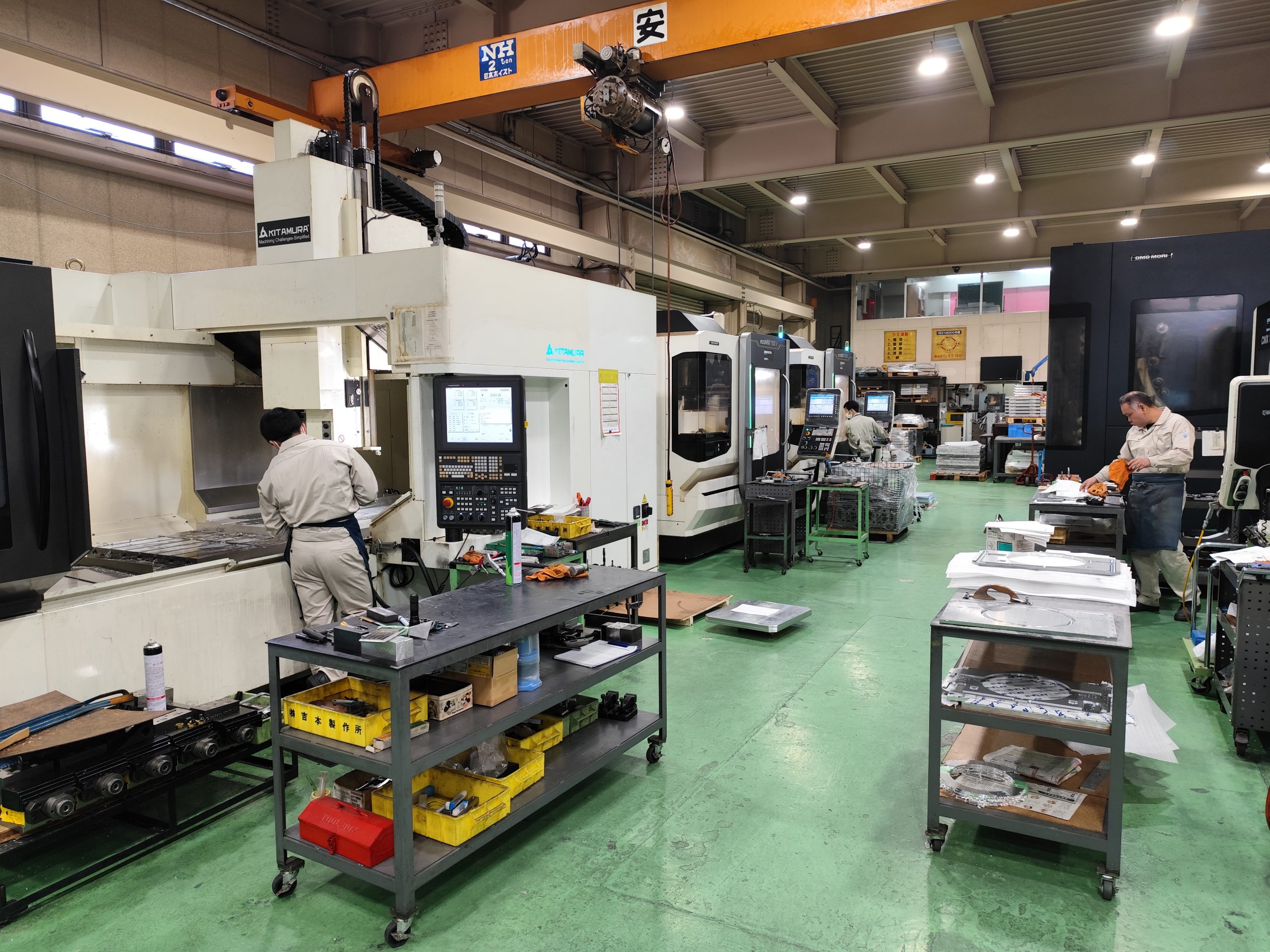
Yoshimoto Vietnam is a precision parts supplier based in Ho Chi Minh City. We coordinate production across a network of approximately 30 vetted partner factories, with independent quality oversight at each stage. Our focus is on technically demanding parts where specification accuracy and production flexibility matter — not on competing for high-volume, low-complexity work.
- Technical review: We provide DFM feedback on every inquiry before quoting
- Tolerance: Geometric tolerances at ±0.05mm (±0.002″) verified by CMM; tighter on specific features
- Material: Independent XRF verification available on request, with lot-level traceability
- Inspection: Dedicated QC team independent of production; inspection reports with every order
- Quantity: Single-piece prototypes supported as standard; no minimum order quantity
- Processes: CNC turning, milling, wire-cut EDM, grinding, heat treatment, and surface finishing coordinated end-to-end
- Industries: Semiconductor equipment, analytical instruments, automated production systems, custom industrial machinery
Our quality management approach draws on over 50 years of precision manufacturing experience from our parent company in Japan — applied pragmatically to meet your actual requirements at competitive Vietnam cost.
Send us your drawings. We will come back with a detailed quote, DFM comments, and a realistic lead time within 2 business days.